

|
There are a number of reasons why an old chimney may need lining. These can be summarised as follows: - 1) The flue is leaking smoke and fumes into other rooms or parts of the building. 2) Condensates or tar are seeping through the chimney walls causing staining either outside or inside the building. 3) The flue is much too large for the type of appliance being used. 4) The flue is too cold. Particularly if on the outside wall, and consequently not drawing properly. 5) If the chimney was built since 1965, but with the liners installed the wrong way up, (regrettably this is quite a common occurrence!), tar and condensate leakage may occur. 6) The old flue surface is eroded, causing leakage, chilling and poor updraft. |

|
For a stove to work successfully it must be connected to a sound chimney and correctly sized flue.The functions of a chimney are to safely remove the products of combustion from the appliance to the outside without causing danger to the occupants or risk setting the house itself on fire. A chimney works on a simple principle "Hot Air Rises" therefore the flue must be well insulated for this to happen.Before proceeding further it is important to understand the terms used: - 1) FLUE - The flue is the passageway through which the products of combustion travel to the outside from the stove. 2) CHIMNEY - This is the structure surrounding the flue/flues. 3) FLUE LINER - The material used to from the flue. 4) STOVE PIPE - The pipe connecting from the appliance to the flue within the chimney Factors such as operating a stove at a low setting for long periods or cool air leaking into the flue, will cool the gases down and affect the performance of the chimney. To keep the flue gases warm, consideration must be given to the insulation value of the lining within the chimney. Most houses built prior to 1965 (before a change in the Building Regulations) were built without liners. Flues were usually "parged" (rendered) on the inside with lime mortar. This parging over a period of time will have suffered attack from the corrosive elements within the flue gases, resulting in erosion and leakage. This can generally be noted by a sand like material falling down the chimney (the old lime mortar) also the mortar between the bricks will have deteriorated in the same way. Houses built after 1966 should have lined flues; this is usually done with clay liners. However, this type of lining is not necessarily suitable for an efficient wood or multi-fuel stove. Very often chimneys are built on the outside of the house and are therefore subjected to the elements. This combined with the fact that insulation around the liners is generally excluded all adds up to a cold flue. Please remember that stove are efficient heating appliances and will produce anything up to 85% of heat from the fuel burnt into the room, unlike an open fire that can loose up to 95%. With little heat loss from an efficient stove it becomes understandable how essential it becomes to retain a reasonable flue gas temperature in order to achieve a natural rise. A lined and well insulated flue will produce an efficient and safe appliance. Unlined flues can result in costly redeemable building work. |
Class 1 liners
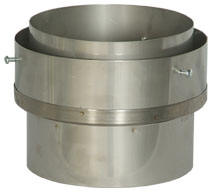
A flue adaptor must be used for connecting
flexible liner to rigid pipes as chimney liners
are wound during construction
they would be damaged or snagged
by chimney sweeping without it
also maintains a smooth passage for
flue gasses.
Office on 01989 770956 or Mike on 07971 661239
email admin@weyfordheritagemasonry.ltd.uk or admin@ heritagechimney.co.uk
